


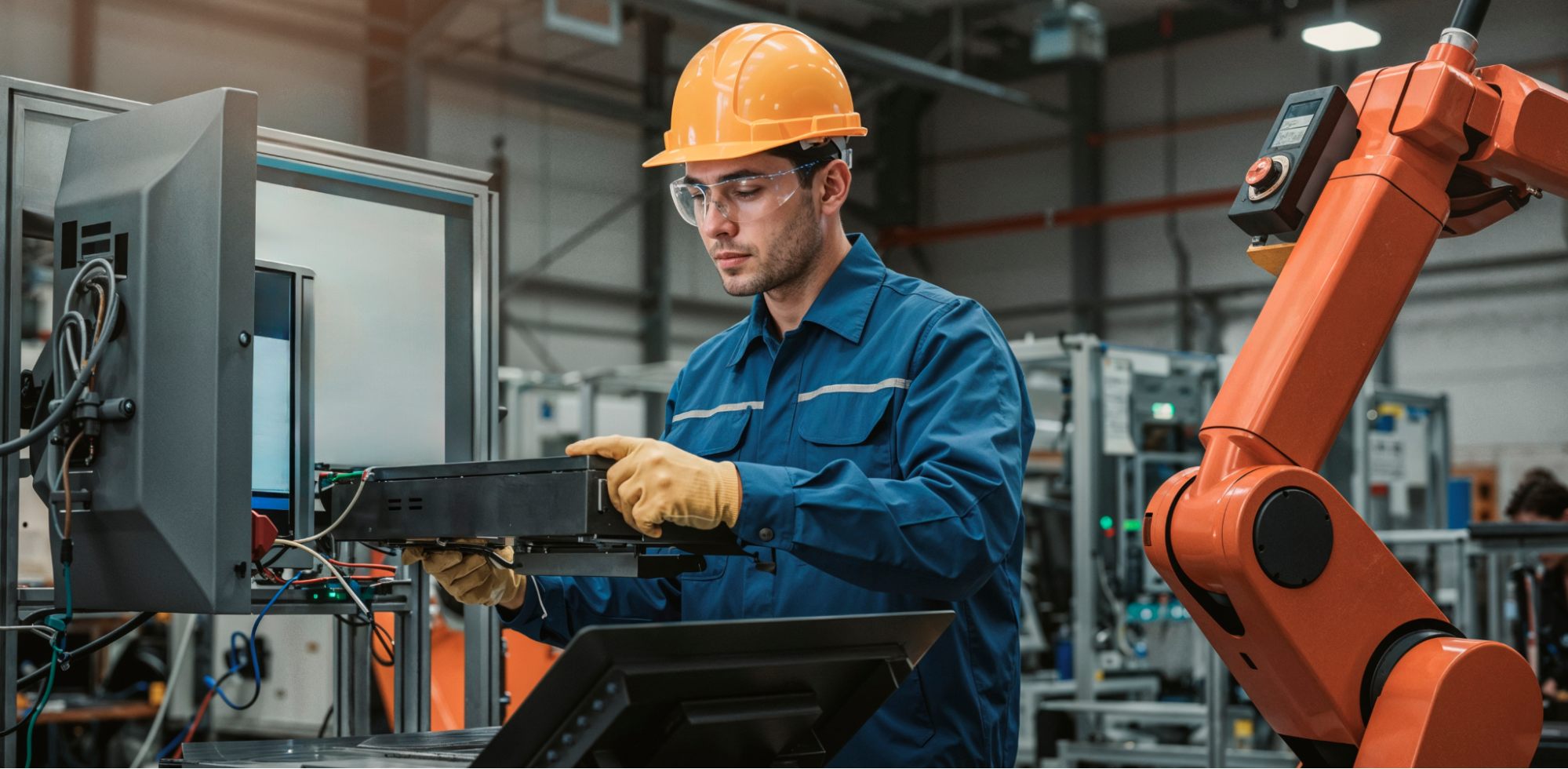
At PSB GmbH, we recognize the increasing need for portable workstation solutions tailored for demanding industrial environments. Our extensive experience in PC-based engineering enables us to design systems that combine mobility with uncompromising robustness and performance. Whether deployed in the field or within a factory, our portable workstations are engineered for reliability and flexibility, supporting critical operations anywhere they are needed. Every solution we deliver is rooted in a deep understanding of industrial requirements, including needs such as extended temperature tolerances, IP protection, and easy adaptability. We approach each project with a manufacturer-neutral perspective, ensuring our systems are optimally aligned with our clients’ technical and workflow demands. Commitment to precision engineering and quality underpins every mobile system we develop.
What is a Portable Workstation for Industry?
A portable workstation for industry is a technologically advanced, mobile work platform specifically designed for demanding industrial environments such as production, logistics, laboratories, and technical fields. These mobile workstations—sometimes called Industrie-PC mobil or mobile Arbeitsstation—enable flexible and ergonomic data collection, IT integration, and workflow management, even in areas without fixed infrastructure. Unlike stationary systems, portable workstations are constructed with robust materials and equipped with high-capacity batteries (or Akkubetriebene Workstation), thus delivering powerful performance completely independent from the power grid (stromnetzunabhängig).
Typical Areas of Application and Advantages
Portable industrial workstations are used across a wide spectrum of industries:
- Logistics & Warehousing: For mobile data collection in industry, such as barcode scanning and order processing directly at storage locations.
- Production & Manufacturing: Facilitate process control, quality assurance, or assembly documentation, making them a crucial flexible workplace solution.
- Laboratories: Used for digital documentation and research process monitoring without interrupting sensitive workflows.
- Healthcare: For electronic health record management at the patient’s bedside or mobile diagnostics.
The main advantages of these mobile workstations include:
- Increased process efficiency by reducing unnecessary walking distances.
- Immediate data availability through on-site IT integration.
- Improved ergonomics and flexibility for tailored workplace organization.
- Adaptability for different industrial environments.
- Enhanced safety, especially with models conforming to IP65 standards for dust and water protection.
For businesses that require continuous operation and robust IT infrastructure, integrating such portable workstations offers clear advantages for workflows and uptime.
Technical Requirements and Equipment Features
The successful implementation of a robust workstation depends extensively on the technical configuration:
- Modularity: The ability to attach printers, scanners, and IT hardware as required.
- Batteries: High battery capacity for several hours of operation; hot-swap capability for uninterrupted processes.
- IT Integration: Seamless connectivity for databases, production software, or cloud systems.
- Interfaces: Sufficient USB, Ethernet, and wireless connections for various industrial hardware and peripherals.
- Environmental Protection: Many models offer IP65 protection, making them suitable for dusty, wet, or otherwise harsh environments.
- Mobility: Durable wheels, adjustable handles, and stable casters for easy movement even with heavy attachments.
Adaptable accessories like shelves, baskets, or additional displays round off the flexible workstation solution. These elements ensure that the mobile workstation can be tailored precisely to specific industrial tasks. For specialized industrial IT needs, it’s also crucial to consider EMC protected computers to guarantee compliance with safety and legal requirements.
Modularity and Individual Customization
One of the most significant features of portable industrial workstations is their modularity. This means companies can configure the mobile workstation individually for their respective use case. Whether a company needs a platform for rugged laptops and industrial PCs (embedded PCs with long-term availability), printers for labels, or extensive battery packs for 24/7 operations—a modular design enables scalability and customization:
- Detachable accessories such as keyboard trays, printer holders, and drawer units.
- Adaptable surfaces for small monitors, large touchscreens, or complete Industrie-PC mobil setups.
- Flexible power management with exchangeable battery modules or charging electronics.
This modularity not only increases productivity but also protects investments, as the workstations can be quickly and cost-effectively adapted to new processes, production lines, or technical requirements.
Ergonomics and Occupational Safety
Ergonomics is a key factor in the design of ergonomic industrial workstations. Portable models offer features such as:
- Height adjustability (höhenverstellbar) to suit standing or seated operation for various employees.
- Ergonomically shaped handles and surfaces that reduce strain during movement and operation.
- Stable construction to avoid tipping risks, even when loaded with heavy equipment.
- Control elements positioned in line with ergonomic standards to reduce fatigue and enhance safety.
Implementing ergonomic features results in fewer musculoskeletal complaints and prevents workplace accidents, thus increasing both satisfaction and productivity. This fits perfectly with best practices for quiet and efficient office server setups that promote a productive, healthy working environment, bridging office and industrial IT needs.
Selection Criteria: What Should Companies Consider?
- Battery capacity and runtime: Ensure the selected accu-powered workstation covers operational requirements without frequent downtime.
- Robustness: Consider models with IP protection or reinforced frames for challenging environments.
- Modular expandability: Can accessories and IT components be seamlessly integrated?
- IT integration: Are there sufficient, compatible interfaces (USB, LAN, Wi-Fi, Bluetooth)?
- Ergonomics: Is the station easily adaptable to diverse employees and working positions?
- Compliance: Does the product meet industry-specific standards such as EMC, IP65, or similar?
- Long-term support: Check for service, replacement parts, and future adaptability—as offered by leading providers for long-term availability of embedded PCs.
A well-defined requirements analysis—ideally supported by an experienced provider—forms the basis for a future-proof investment.
Practical Examples: Mobile Workstations in Industrial Everyday Life
Production: In an assembly plant, a portable workstation enables employees to monitor process data and record quality checks directly at the production line, minimizing response times and reducing errors.
Logistics: In a warehouse, a mobile workstation with an integrated scanner and tablet streamlines inventory management and shipping documentation. For example, order picking can be digitally captured and immediately transmitted to the ERP system.
Laboratories: Technicians use akkubetriebene Workstations to enter measurement results or barcode samples throughout the lab—thanks to IP65 protection, the units withstand accidental liquid spills or cleaning measures without damage.
Healthcare: Nurses manage patient data with a height-adjustable, robust workstation at the bedside, which improves workflow and hygiene.
To optimize uptime, many organizations integrate computers for continuous operation into their mobile workplace solutions, ensuring reliable data acquisition and IT performance around the clock.
Future Trends: Digitalization and Mobile Workplaces
The trend toward smart factories and Industry 4.0 is fueling the development of intelligent, mobile workstation concepts. Modern portable industrial workstations increasingly feature:
- Integration of IoT sensors and real-time data acquisition for process optimization.
- Cloud connectivity for centralized management and access to company-wide applications anywhere in the facility.
- More efficient, environmentally friendly batteries with higher energy densities and rapid charging capabilities.
- Advanced modular systems that support predictive maintenance and future hardware upgrades.
- Enhanced cybersecurity features, in line with legal and industry requirements, for robust mobile data collection in industry environments.
As digitalization advances, flexible workplace solutions will become even more essential for competitiveness and innovation in industrial settings. Choosing adaptable, powerful mobile workstations positions companies for the upcoming wave of IT- and process-driven transformation in production, logistics, and technical workspaces.
Portable workstations have become a cornerstone for increased efficiency and agility within modern industrial processes. Drawing upon decades of expertise, PSB GmbH ensures that each system upholds the highest standards for durability, serviceability, and user-specific customization. Our thorough in-house development and rigorous testing approach guarantee operational reliability, even under the toughest conditions. Clients benefit from our flexible manufacturing and consistent delivery capabilities, fostering lasting collaboration and trust. As industrial requirements evolve, PSB GmbH remains a dependable partner for innovative, future-ready portable workstation solutions.


