We always look at condition monitoring in the context of the specific application: which machine states need to be captured, at what interval, and with what relevance for operations? For us, the key is to align the data source, sensors, and evaluation so that measurements turn into usable information. It is just as important to integrate the solution cleanly into the existing IT and OT environment so it runs reliably and fits the day-to-day setup.
Condition monitoring is the basis for systematically capturing machine health and detecting deviations early. It makes condition-based maintenance practical and, with enough reliable data, also opens the path toward predictive maintenance. For technical decision-makers, the operational value is clear: irregularities can be identified earlier, unplanned downtime can be reduced, and maintenance work can be planned more effectively.
To turn measurements into usable information, sensors, data acquisition, evaluation, and integration must be considered together. Hardware plays a central role here as well: it influences how reliably data is captured, processed, stored, and passed on to existing systems.
What Condition Monitoring Does and How It Differs from Predictive Maintenance
Condition monitoring means regularly or continuously capturing and assessing the current machine condition. The goal is to make changes from a normal or expected state visible. In most cases, it is not just about individual values, but about how they develop over operating time. A snapshot may provide a hint, but it is often not enough to classify the significance of a deviation properly.
Predictive maintenance is different. While condition monitoring describes and evaluates the current state, predictive maintenance tries to infer future maintenance dates or failure risks from this data. That is more demanding because it usually requires historical data, known operating states, and documented fault and maintenance events. Without a solid data base, a clear forecast is often harder to achieve than reliable condition monitoring.
It is also important to distinguish machine monitoring from process monitoring. Machine monitoring focuses on the technical condition of the plant, such as bearings, drives, or lubrication. Process monitoring, by contrast, looks more closely at the production flow and output quality. In practice, the two areas often overlap, but this article focuses on the technical condition of the machine.
Which Condition Data and Measurement Variables Matter
Which data make sense depends on the fault pattern and the application. Typical condition variables include vibration, temperature, pressure, speed, acoustics, electrical values, and oil or lubricant condition. Depending on the component, these values can reveal very different issues. That is why the same sensor setup is not suitable for every machine.
For electric motors, pumps, and fans, vibration, temperature, current draw, and speed are often relevant. They can indicate imbalance, bearing problems, overload, or thermal anomalies. For gearboxes and other rotating drives, vibration spectra and oil condition also play a major role because tooth damage or lubrication issues often show up there early. In compressors and process plants, pressure, temperature, and vibration data help detect leaks, wear, or operating deviations. Machine tools often benefit from a combination of vibration, acoustic signals, temperature, and process data, for example when tool wear or instability needs to be detected. In hydraulic systems, pressure, temperature, and oil or particle condition are key variables for assessing filter, valve, or leakage issues.
Selecting Measurement Variables by Application
Choosing the right measurement variable is always a question of the objective. If you want to assess bearing condition, you need different signals than you would for temperature limits or pressure curves. That is why the measurement goal, sensor type, and expected fault pattern should always be considered together. A well-chosen variable significantly increases the value of the data, while an unsuitable measurement may generate data but very little reliable insight.
In practical terms, this means first defining which deviation needs to be detected, then selecting the sensors, and finally choosing the right evaluation method. This avoids collecting too much irrelevant data or missing critical changes.
Accounting for Operating Conditions
Threshold values alone are often not enough. Measurement values must be interpreted in the context of speed, load, process step, and environment. A vibration value that is unremarkable at no load may be normal under high load – or, compared with normal operation, already indicate a relevant change. That is why comparing the data with reference states or trends over time is often more informative than looking at a single number.
For a reliable assessment, it helps to define and document operating states. Only then can changes be evaluated in the right context and misinterpretations be reduced. This is especially important when process conditions change frequently, because the same reading can mean different things depending on the situation.
How a Condition-Monitoring System Is Structured
A condition-monitoring system can be sensibly divided into three layers: data acquisition, data processing, and visualization plus action control. This structure helps organize the technical task clearly. Sensors alone are not enough, because the data only becomes useful through time stamping, plausibility checks, filtering, storage, and analysis.
In practice, sensors are often combined with control data from the PLC. Existing machine data such as operating states, cycles, or process values can also be included. Retrofit solutions for existing plants are also important, because not every machine was designed for condition monitoring from the start. Depending on the architecture, edge systems or industrial PCs perform local preprocessing and buffering before data is passed to central systems. This, however, also increases the requirements for computing power, storage, interfaces, and operational reliability.
Data Acquisition at the Machine and Control Level
On the first level, the relevant signals are captured directly at the machine or via the control system. This can be done through additional sensors or through already available machine data. What matters is that the data is available in a way that matches the fault pattern and can be clearly assigned. This combined approach is often especially relevant in brownfield plants, meaning existing systems in ongoing operation.
Data acquisition should be designed so that it does not unnecessarily disrupt operations while still delivering enough quality for later analysis. This includes clean time alignment as well as suitable signal transmission.
Data Processing and Analysis
At the processing level, signals are prepared, checked, and analyzed. Typical tasks include signal filtering, feature extraction, trend analysis, and anomaly detection. Raw data is turned into metrics or patterns that are easier to interpret in daily operations. For complex or rare fault patterns, machine-learning methods can also be useful when simple rules or fixed thresholds are no longer sufficient.
It is important that analytical methods always match the data situation. An advanced algorithm cannot replace good sensor design or a reliable data base. Conversely, a well-configured rule-based evaluation can already provide valuable indications if the fault pattern is clearly defined.
Visualization, Alerts and Integration
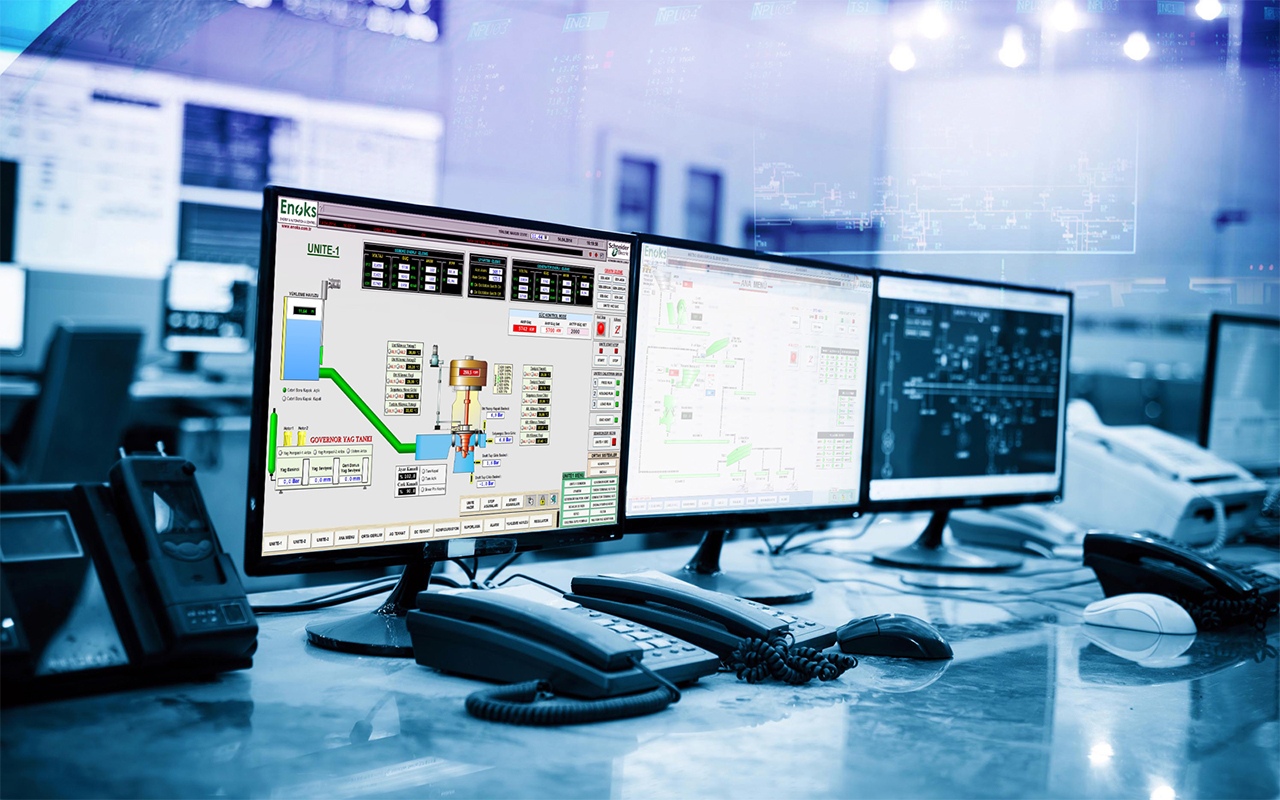
The third layer makes conditions usable in operations. This includes trend displays, condition classes, warnings, and diagnostic hints. These outputs should be passed to maintenance or control systems so that an irregularity can be turned into a concrete action. An alarm is only helpful if it is clear who responds, what needs to be done, and within what time frame action is required.
That is why a good alarm concept needs more than threshold values. It must distinguish between warning, critical condition, and possible shutdown, and link these stages to clear responsibilities. Only then does monitoring remain manageable in everyday use and avoid unnecessary alarm noise.
Which Criteria Determine the Technical Solution
The technical solution should be derived from the monitoring objective, not the other way around. The decisive factors are the expected fault pattern, operating conditions, retrofit capability, data quality, alarm concept, integration into existing systems, and operational reliability. For B2B applications, it is especially important that sensor position, sampling rate, storage needs, response time, and interfaces fit the specific use case.
Poor data quality is a major risk here. If sensors are placed badly, calibrated insufficiently, or integrated incorrectly, false alarms can occur or damage can be missed. Good results therefore come not from having more sensors alone, but from a coherent overall architecture.
Retrofit and Brownfield Plants
In existing plants, condition monitoring is often based on a combination of additional sensors and already available machine data. This is especially relevant when production systems were not planned from scratch. Brownfield projects therefore usually require careful technical integration so that monitoring fits into the existing infrastructure without placing unnecessary strain on ongoing operations.
The benefit lies mainly in making critical components visible in a targeted way. Whether and to what extent a retrofit is worthwhile always depends on the plant, the available data, and the economic goal.
Alarm Strategy and Response Concept
A good alarm concept clearly separates warning, critical condition, and shutdown. This differentiation is important so that not every deviation triggers the same response. Only when it is defined which action follows which condition can a monitoring system reliably support day-to-day work.
An alarm strategy therefore also includes a response concept: who is informed, who checks the message, and what action is triggered? Without this assignment, alerts may be visible but will not automatically lead to better maintenance.
Operational Reliability and Robust Infrastructure
For continuous operation, robust systems with local buffering, suitable storage architecture, and uninterruptible power supply are sensible. Equally important is a maintenance-friendly replacement concept for components that may need to be swapped in the field. In industrial environments, protection rating and temperature design are also essential because the hardware must work reliably under demanding conditions.
The technical design should therefore consider not only the analysis function, but also availability, maintainability, and environmental robustness. Especially for permanently running monitoring solutions, this is a key part of the overall decision.
How Condition Monitoring Fits into the IT Hardware Strategy
For the hardware strategy, condition monitoring is not a single application but a continuous chain from the sensor to the maintenance action. This creates concrete requirements for industrial PCs, servers, or embedded systems: they must capture data, process it locally or centrally, store it reliably, and integrate into existing OT and IT structures. In many projects, the focus is therefore not on one product, but on a customer-specific configuration of computing power, interfaces, storage, and expandability.
The connection between edge processing, central storage, and existing infrastructure is especially important. Local systems can handle preprocessing and buffering, while central platforms provide long-term data, histories, and cross-machine analysis. If you want to connect machines, you should also consider data paths and interfaces early; further background can be found on the page Connect machines: which data and interfaces are needed?.
Requirements for Industrial PCs, Servers and Embedded Systems
Industrial PCs, servers, and embedded systems can take on different roles in a condition-monitoring architecture. An edge computer can preprocess data and buffer events locally, a server can handle central storage and analysis, and an embedded system is suitable for compact, application-specific tasks with clearly defined interfaces. The decisive factor is not the form factor alone, but durable, maintainable, and integration-friendly operation.
Depending on the application, different properties may be central: sufficient computing power for analysis tasks, stable storage solutions for time series and events, industrial interfaces for sensors and control systems, and an architecture that allows later expansion.
Interfaces and Data Integration
For practical value, connections to PLC, SCADA, MES, and historian systems are often just as important as the actual data capture. The value of condition data only becomes visible when it reaches the systems where maintenance, production, and engineering work with it. That is why existing infrastructure should always be considered, rather than treating a monitoring solution in isolation.
Integration capability also determines how well results can be reused. If alarm messages, metrics, and diagnostic information are cleanly transferred into existing systems, a continuous information flow is created from sensor to action.
Limits, Risks and the Right Economic Use Case
Condition monitoring is effective, but it has limits. An identified anomaly first shows a deviation, not automatically the cause. False alarms can also occur, for example due to changing loads, process steps, sensor faults, or mounting changes. Machine-learning methods also require a suitable data base; without representative and correctly assigned data, their usefulness is limited.
It is equally important to separate condition monitoring from safety functions. Condition monitoring does not replace a validated protection or emergency shutdown function. In critical plants, suitable rules and technical safety concepts must still be in place. Economically, monitoring makes the most sense where failures are expensive, components are critical, or downtime has a major impact. For non-critical and easily replaceable parts, a simpler maintenance strategy may be sufficient.
In summary, condition monitoring is an effective way to make machine health transparent, schedule maintenance more reliably, and design technical systems more effectively. Its value, however, only emerges when measurement variables, evaluation, hardware, and integration environment are consistently matched to the specific application.
For the hardware decision, we recommend not starting from a standard platform, but instead deriving computing power, interfaces, and environmental requirements directly from the actual data volume and the intended analysis. This allows industrial PCs, servers, or embedded systems to be configured so they fit your plant reliably and economically. We support you with structured requirements analysis, manufacturer-independent component selection, prototyping, as well as software installation and hardware testing. If you would like to align your application and requirements with us, we would be pleased to discuss them with you.